
Digital Twins

Updated: Jul 15
Digital Twins in Telecom: From Virtual Models to Trusted Networks
The digital twin has become one of the most compelling ideas in telecoms. The principle, formalised in ITU-T Y.3090, is straightforward: build a virtual representation of the physical network that you can analyse, diagnose, emulate and control, with a real-time mapping kept in step between the two. Run a "what-if" against the twin instead of the live network. Let an AI loop rehearse an optimisation in the model before it executes in the field. Predict a fault before subscribers ever feel it.
As 5G matures and emerging technologies such as Artificial Intelligence (AI), Open RAN, edge computing, Non-Terrestrial Networks (NTN), and private wireless networks continue to evolve, connectivity is becoming more intelligent—but also significantly more complex.
Networks today support far more than mobile subscribers. They underpin smart factories, ports, airports, railways, utilities, healthcare, public safety, connected vehicles, industrial automation, and satellite communications. Every new service, connected device, and software update adds another layer of complexity to network operations.
To manage this growing complexity, the industry is increasingly turning to Digital Twins.
Originally developed in manufacturing and aerospace, Digital Twins are now emerging as one of the most promising technologies for the telecommunications sector, enabling organisations to better understand, predict, and optimise network behaviour before changes are introduced into live environments.
But while the concept is compelling, one important question remains:
How can organisations ensure that their Digital Twin continues to reflect the real world?
What Is a Digital Twin?
A Digital Twin is a dynamic virtual representation of a physical asset or system that is continuously updated using operational data.
Within telecommunications, a Network Digital Twin can model:
Radio Access Networks (RAN)
Core network functions
Transport infrastructure
Devices and terminals
Applications and services
Customer and enterprise traffic patterns
Network performance and Quality of Experience (QoE)
Unlike traditional planning models, a Digital Twin evolves continuously, allowing organisations to simulate network changes, evaluate different scenarios, predict performance, and reduce operational risk before making changes to production networks.
Rather than reacting to problems after they occur, organisations can proactively identify issues, optimise resources, and improve service quality.
Digital Twins Are Transforming the Entire Connectivity Ecosystem
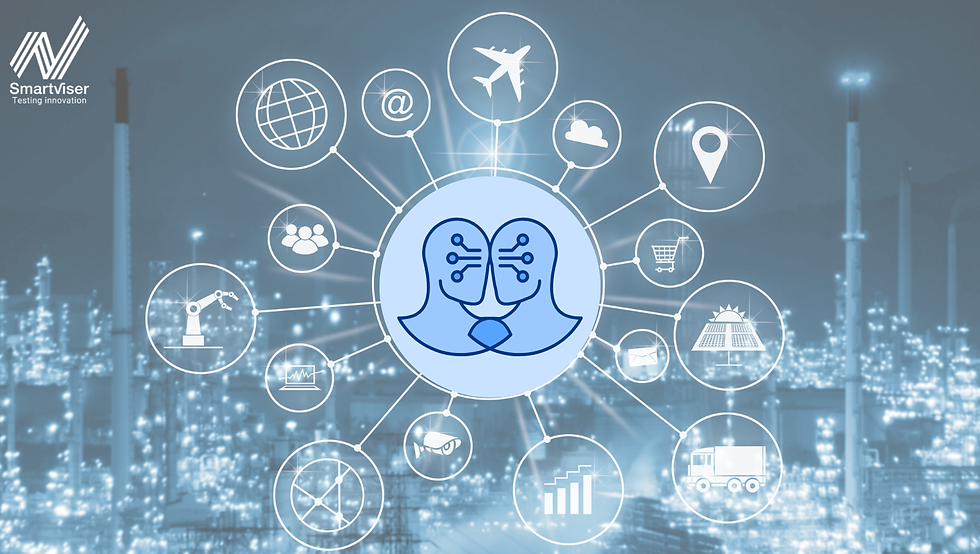
Although the concept is often discussed in the context of national mobile operators, Digital Twins have the potential to transform almost every organisation responsible for delivering connectivity.
For mobile network operators, Digital Twins offer a way to manage increasingly sophisticated multi-vendor environments while accelerating the deployment of new technologies such as 5G Standalone, Open RAN, network slicing, and AI-assisted optimisation.
For Mobile Virtual Network Operators (MVNOs), the value lies in understanding customer experience. While MVNOs may not own the underlying radio infrastructure, they remain accountable for the quality of the services they provide. A Digital Twin can help them evaluate roaming performance, compare service quality across host networks, and identify opportunities to improve customer satisfaction.
The same principle applies to the rapidly growing private wireless market. Manufacturers, ports, airports, logistics hubs, mining operations, utilities, and healthcare organisations are increasingly deploying dedicated LTE and 5G networks to support business-critical operations. Before introducing new applications, expanding coverage, or modifying network configurations, Digital Twins provide an opportunity to understand the operational impact without disrupting day-to-day activities.
Mission-critical organisations face an even greater responsibility. Emergency services, transportation authorities, defence organisations, and operators of critical national infrastructure cannot afford uncertainty. A Digital Twin enables these organisations to rehearse major incidents, simulate network failures, or evaluate emergency response scenarios in a safe environment, helping improve operational readiness before those situations occur in reality.
Meanwhile, the rapid evolution of Non-Terrestrial Networks is extending the reach of telecommunications far beyond traditional terrestrial infrastructure. As satellite connectivity becomes an integral part of the 5G ecosystem, Digital Twins offer an effective way to model hybrid terrestrial and satellite environments, evaluate service continuity, and understand mobility across increasingly complex coverage areas.
Although the use cases differ, they all share the same objective: making better operational decisions before those decisions affect live services.
Why Digital Twins Matter

Modern communications networks are evolving faster than ever.
Software is updated continuously.
New devices are introduced every month.
Radio conditions change throughout the day.
Applications evolve.
Customer behaviour shifts.
Network traffic patterns become increasingly dynamic.
Traditional network management often identifies issues only after users experience them.
Digital Twins introduce a more proactive approach by enabling organisations to:
Simulate network changes before deployment
Predict the impact of software upgrades
Optimise network capacity and coverage
Evaluate resilience under different operating conditions
Accelerate service innovation
Reduce operational costs
Improve customer Quality of Experience
Support AI-driven network automation
They allow organisations to move from reactive operations towards predictive and, ultimately, autonomous network management.
The Challenge: A Digital Twin Is Only as Good as Its Data
Despite their potential, Digital Twins have one important limitation.
They are only as accurate as the information used to build and maintain them.
Networks are living systems that evolve continuously.
Software updates introduce new behaviours.
Devices respond differently.
Applications generate changing traffic patterns.
Environmental conditions influence radio performance.
If these changes are not reflected within the Digital Twin, its predictions gradually become less reliable.
A sophisticated model that no longer reflects operational reality can lead to poor decisions rather than better ones.
Moving Beyond Network KPIs
Traditional assurance has focused on technical metrics such as:
Throughput
Latency
Packet loss
Signal strength
Handover success
Network availability
While these remain essential, they do not always represent what users actually experience.
Ultimately, customers measure success differently.
Can they complete a video call?
Does a remote healthcare consultation remain stable?
Can emergency responders communicate without interruption?
Do autonomous vehicles maintain continuous connectivity?
Does a manufacturing robot receive commands within the required time?
Digital Twins therefore need to represent not only network performance, but also real service performance and user experience.
Closing the Loop with Real-World Validation
The most effective Digital Twins are not static planning tools.
They operate within a continuous feedback loop. Operational measurements update the Digital Twin. The Digital Twin predicts the impact of proposed changes.
AI or network engineers recommend actions. Changes are introduced into the live network. Automated testing validates voice, data, messaging, video, and application performance. Real-world customer experience is measured.
The results feed back into the Digital Twin, improving its accuracy over time.
This continuous validation process transforms the Digital Twin from a simulation platform into a trusted operational asset.
Why Automation Is Essential
Continuous validation cannot rely on occasional manual testing.
Today's communications networks operate across thousands of locations, multiple access technologies, millions of devices, and increasingly diverse services.
Automation enables organisations to:
Validate end-to-end services continuously.
Measure application performance across different network technologies.
Compare predicted performance with actual behaviour.
Detect service degradation before customers are affected.
Validate software updates and new device releases.
Support continuous optimisation across terrestrial and satellite networks.
Measure Quality of Experience using real devices in real environments.
Automation provides the operational evidence needed to keep Digital Twins aligned with reality.
From Digital Twins to Autonomous Networks
The industry is steadily moving towards AI-assisted and autonomous network operations.
In this future operating model, Digital Twins become the environment where network changes can be safely evaluated before deployment.
Artificial Intelligence can analyse network conditions, recommend optimisation strategies, and predict future performance.
However, AI is only as reliable as the Digital Twin on which it depends, and the Digital Twin is only as reliable as the real-world data used to validate it.
The future operating model is likely to follow a continuous cycle:
Observe → Model → Predict → Validate → Learn → Improve
This closed-loop approach will allow organisations to innovate faster while maintaining the reliability, resilience, and customer experience expected from modern communications networks.
Turning Digital Twins into Trusted Operational Assets
As Digital Twins become an integral part of next-generation network operations, one principle will remain constant: a model is only as valuable as its ability to represent reality.
Simulation, prediction, and AI-driven optimisation can significantly accelerate innovation, but they must be continuously validated against the experience of real users, real devices, and real networks. Without that feedback, a Digital Twin risks becoming an infrastructure model rather than a true representation of service performance.
This is where SmartViser's portfolio helps organisations close the loop.
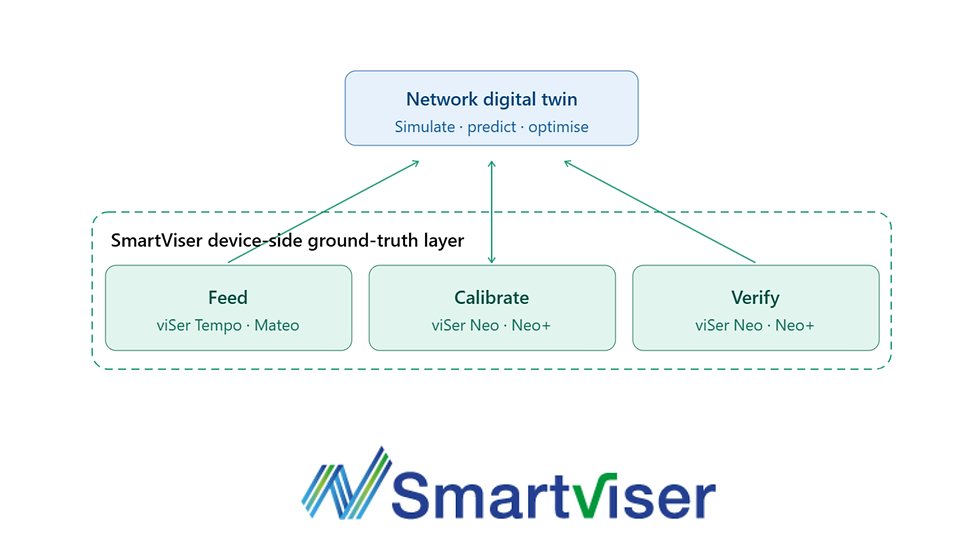
viSer Tempo provides continuous active network monitoring, while viSer Mateo captures passive measurements from devices operating in real-world conditions. Together, they feed the Digital Twin with the live Quality of Experience (QoE) and Quality of Service (QoS) data that infrastructure counters alone cannot provide. They add the user experience dimension that keeps a Digital Twin aligned with operational reality.
When a Digital Twin predicts the outcome of a network change, that prediction needs to be verified. viSer Neo and viSer Neo+ provide controlled, repeatable testing on real commercial devices, enabling operators, enterprises, private network owners, and mission-critical organisations to validate voice, data, video, messaging, and application performance under real operating conditions. Rather than relying solely on simulation, organisations can confirm whether predicted behaviour matches what users actually experience and recalibrate the Digital Twin whenever differences emerge.
As the industry moves towards AI-assisted and autonomous networks, this independent validation becomes even more important. Whether an optimisation is recommended by an AI engine, a Self-Organising Network (SON) function, or another automation platform, SmartViser's solutions provide objective, device-centric measurements that verify whether the change genuinely improved the end-user experience—not simply the network performance counters.
In other words, SmartViser delivers the missing "Verify" stage in the autonomous networking lifecycle, creating a continuous feedback loop where simulation, automation, validation, and learning work together.
Digital Twins may predict. AI may optimise. But only continuous real-world measurement can confirm that the network is delivering the experience users expect.
If the future of telecommunications is built on trusted Digital Twins, then the future of those Digital Twins will be built on trusted validation—and that is where SmartViser is helping organisations transform insight into confidence.

Susie Siouti is the Chief Commercial Officer for SmartViser helping organisations in the Telecommunications industry offer superior end-user quality of experience and service with the introduction of innovative test automation products. Susie has 20 years of experience in the Telecoms industry and in that time has led teams across the world mainly in Testing and Compliance. Holding an MBA from Henley Business School brings a diverse set of skills and expertise, including business acumen, strategic thinking, financial management, sales and marketing expertise, leadership, and innovation.
Susie joined SmartViser in 2016, is part of the internal steering committee, responsible for developing and implementing the company's commercial strategy and encouraging a customer-centric culture. The main mission is to help organizations to create value by offering better quality products and services by improving operational efficiency and innovation.


At https://neosurfcasinosite.com, I've seen how a simulation is only as trustworthy as the data you feed it, so the article's focus on keeping the digital twin in real-time sync with the live network really resonated. The AI rehearsal idea is elegant, but I'd be curious how they handle latency when the twin has to mirror a rapidly changing edge environment.