
Mission-Critical Communications

The Future of Mission-Critical Communications: From Coverage Challenges to Continuous Assurance

Mission-critical communications has firmly emerged as one of the defining themes shaping the industry in 2026.
From the global stage at Mobile World Congress 2026 to the UK-focused discussions at BAPCO Annual Event 2026, one message is clear:
the expectations placed on public safety networks are increasing faster than ever before.
As organisations transition from legacy systems to broadband technologies, the challenge is no longer just about enabling connectivity—it’s about guaranteeing performance, resilience, and trust in real-world conditions.
Voice Remains the Foundation—But Expectations Are Evolving

While data, video, and AI-driven capabilities are rapidly expanding, mission-critical voice still underpins emergency operations.
However, moving from TETRA to LTE and 5G introduces new challenges:
Less predictable coverage
Increased dependency on network conditions
Greater variability in user experience
For emergency responders, this shift is not just technical—it’s operational. The need is no longer just connectivity, but guaranteed performance in real-world conditions.
Coverage and Resilience: The Reality Behind the Transition
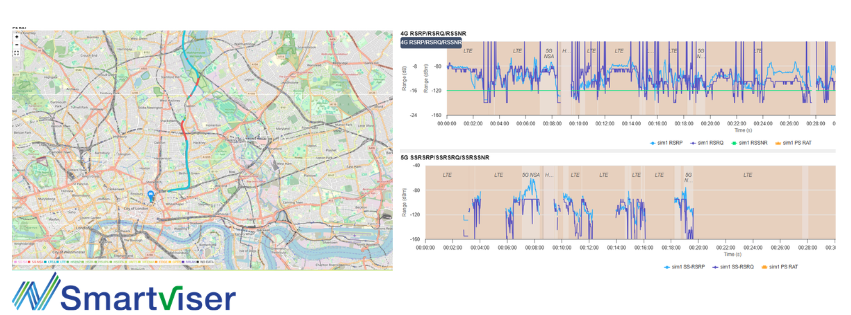
One of the biggest misconceptions is that modern networks automatically outperform legacy systems.
In reality:
Higher-frequency networks (4G/5G) create more localized coverage gaps
Indoor performance remains a significant challenge
Network changes often lead to user-perceived degradation, even when overall performance improves
At the same time, resilience is evolving from:
Single-network reliability → Multi-layered service assurance
This means organisations must move beyond infrastructure and ask:
“How do we continuously verify that services are actually working for the end user?”
SmartViser Approach: From Validation to Continuous Assurance
To successfully transition to broadband mission-critical communications, organisations must address two key needs:
Validate and test services before deployment
Continuously monitor and assure performance in live operations
SmartViser supports both phases with a comprehensive, device-based approach.
1. Active Testing – Validating Mission-Critical Services Before Deployment

Before any rollout, it is essential to validate that mission-critical services perform as expected under real conditions.
With viSer Neo and viSer Neo+, SmartViser enables:
End-to-end testing of MCX services, including:
Push-to-Talk (MCPTT)
Data services and application performance
Measurement of key KPIs such as:
Call setup time
Mouth-to-ear latency
Audio quality (POLQA-based MOS)
Data throughput and latency
Execution of automated, repeatable test scenarios across:
Lab environments
Field conditions
Mobility and drive testing
With viSer Neo+, operators can go even deeper:
Low-layer signalling analysis
RF measurements and cell-level insights
Advanced troubleshooting and optimisation
Outcome: Ensure mission-critical services are fully validated, benchmarked, and ready for operational use before deployment.
2. Service Assurance – Continuous Monitoring in Live Networks
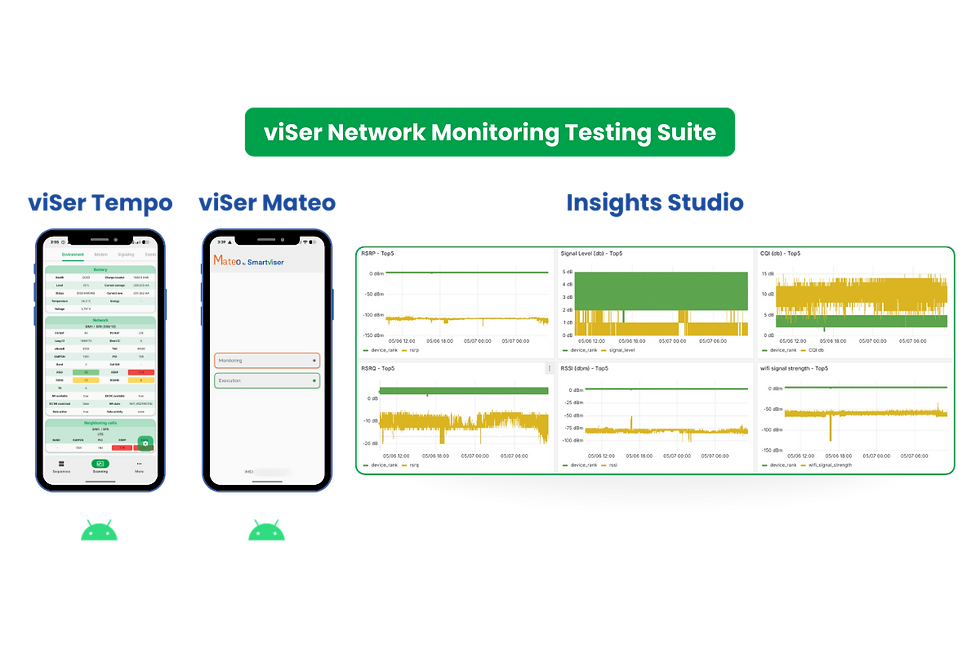
Validation alone is not enough. Once deployed, services must be continuously monitored to ensure consistent performance over time.
SmartViser enables full service assurance through:
viSer Tempo – Active Monitoring
Continuous execution of automated test scenarios
Real-time validation of service availability and performance
Early detection of degradation before it impacts users
viSer Mateo – Passive Monitoring
Collection of real usage data from operational devices
Insight into actual user experience and environmental conditions
Identification of trends, anomalies, and intermittent issues
Outcome: From periodic testing → continuous, real-time assurance of QoE and QoS
Customer Story: ACMOSS and the French RRF Programme

A strong example of this approach in action is ACMOSS and the deployment of the Réseau Radio du Futur (RRF)—France’s nationwide mission-critical broadband network.
To ensure performance and user experience across this complex, multi-operator environment, ACMOSS implemented SmartViser viSer Tempo as part of its operational framework.
Key highlights include:
Deployment of automated smartphone-based testing farms simulating real user behaviour
End-to-end validation of MCX services, including voice, Push-to-Talk and data
Measurement of critical KPIs such as:
PTT access time
Mouth-to-ear latency
Audio quality (MOS)
Integration into the Network Operations Centre (NOC) for real-time visibility
This approach allows ACMOSS to:
Continuously monitor service performance across the RRF
Detect issues before users are impacted
Maintain service continuity and resilience at all times
As highlighted in their publication, this data-driven methodology ensures that critical communications remain available and performant across all operators and scenarios.
Read the full customer story here:ACMOSS RRF Quality of Experience Article
Multi-Bearer Future: Testing the Complexity of Tomorrow

The future of mission-critical communications is multi-bearer:
4G / 5G
Satellite (LEO constellations)
Private networks
Wi-Fi and hybrid connectivity
This creates a new level of complexity:
Dynamic switching between networks
Variable latency and bandwidth
Increased risk of service disruption
SmartViser solutions allow operators and agencies to:
Validate performance across all bearers
Ensure seamless service continuity
Benchmark hybrid connectivity strategies
From Reactive to Proactive: A New Operational Model

Historically, mission-critical communications have been managed reactively:
Issues are reported → investigated → resolved
But in a 5G and multi-service world, this model is no longer sufficient.
The new model is:
Continuous monitoring
Early detection of degradation
Data-driven optimisation
SmartViser enables this transformation by combining:
Active testing (viSer Neo / Neo+)
Continuous monitoring (Tempo)
Real user insight (Mateo)
Conclusion: Enabling the Future of Mission-Critical Communications
The transition to broadband and multi-bearer communications is inevitable—but success is not guaranteed.
To deliver on the promise of:
Reliable voice
Real-time data
Seamless user experience
Organisations must adopt a new mindset:
From network-centric → experience-centric
From reactive → proactive
From assumptions → measurable assurance
SmartViser enables this transformation by covering the full lifecycle:
Validation before deployment (viSer Neo / Neo+)
Continuous assurance in live networks (Tempo / Mateo)
Meet Us to Learn More

Want to explore how SmartViser can support your mission-critical strategy?
Join us at the Critical Communications World 2026 in London, taking place 16–18 June.
Come and meet our team to discover how SmartViser solutions can help you ensure performance, resilience, and real user experience across your networks.

Susie Siouti is the Chief Commercial Officer for SmartViser helping organisations in the Telecommunications industry offer superior end-user quality of experience and service with the introduction of innovative test automation products. Susie has 20 years of experience in the Telecoms industry and in that time has led teams across the world mainly in Testing and Compliance. Holding an MBA from Henley Business School brings a diverse set of skills and expertise, including business acumen, strategic thinking, financial management, sales and marketing expertise, leadership, and innovation.
Susie joined SmartViser in 2016, is part of the internal steering committee, responsible for developing and implementing the company's commercial strategy and encouraging a customer-centric culture. The main mission is to help organizations to create value by offering better quality products and services by improving operational efficiency and innovation.


Comments